
Cytotoxicity & Cell Safety
In vitro cell compatibility of the Herba-Top extract range

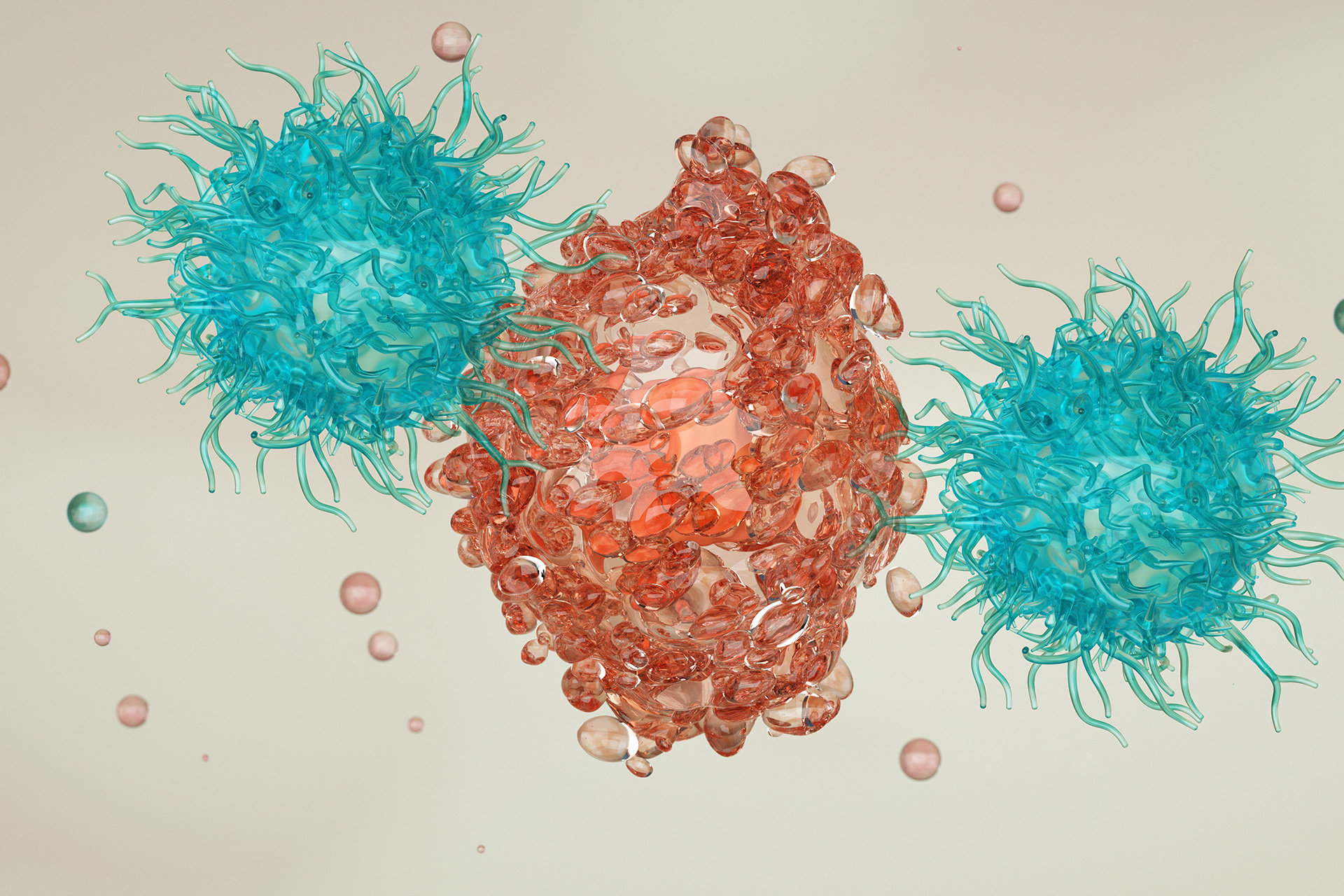
Why This Testing Matters
"Plant-based" is a statement about origin, not about safety. A phytogenic product given in drinking water every day for seven to fourteen consecutive days has to be able to answer a question that no efficacy trial asks: what does the extract do to the host's own living cells? In vitro cytotoxicity screening is the standard first-pass answer, and it is the part of the evidence file that most herbal veterinary products simply do not have.
Two things need testing, not one. Because ethanol 70° cannot be used in registered nutritional supplements for animals, this range is extracted with propylene glycol - so the vehicle itself has to be screened alongside the finished products. It was, as its own full dilution series, which is what makes the results interpretable rather than merely reassuring.
The conventional yardstick comes from ISO 10993-5, which treats a fall in cell viability below 70% of the untreated control as an indication of cytotoxic potential. That threshold is used throughout this page as the reference line. It is worth noting that most published cytotoxicity work on plant extracts asks the opposite question - whether an extract kills tumour cells - and is run on cancer cell lines for that reason. This study did the reverse: it used a normal, non-tumour human cell line and asked whether the extract leaves healthy cells alone.
Test System and Endpoint
- Cell line: HFL-1 - a normal human fetal lung fibroblast line (not a tumour line), seeded at 1 × 10⁵ cells per well in 96-well plates.
- Exposure: 24 h for the culture to establish, then 24 h of exposure to a ten-step serial dilution series of each product, from 1/10 to 1/5120.
- Endpoint: MTT assay (Mosmann, 1983) - mitochondrial dehydrogenase reduces MTT to formazan, so the signal is proportional to the number of cells with functioning mitochondria. 100 µl MTT (0.5 mg/ml in HBSS), 2 h at 37 °C, formazan solubilised in DMSO, optical density read at 450 nm (Sumal PE2, Carl Zeiss Jena).
- Calculation: % viability = (mean OD of sample / mean OD of untreated control) × 100. Results expressed as mean ± standard deviation and compared statistically against the 100% viability of the untreated control.
- Controls: untreated cells cultured under identical standard conditions (= 100%), plus a propylene glycol vehicle arm run through the identical dilution series.
- Products screened: fifteen - Herba Top Entero Mamifer, Herba Top Pneumo Mamifer, Tinctura Herba Prim, Tinctura Herba Vital, Tinctura Rumdigestin Herba, Trichomonas Mamifer, Tinctura Herba Top Broncho, Herba Top Digest, Tinctura Herba Sol, Herba Top Entero Pui, Coccidioza Mamifer, Tinctura Herba Top Trichomonas păsări, Tinctura Herba Top Coccidii păsări, Herba Top Imuno, Herba Top Pneumo Pui.
Research Studies
Study 1 - In vitro cytotoxicity screening of the product range (MTT / HFL-1)
Title: Testarea efectului citotoxic al produselor selectate Promedivet SRL (Cytotoxicity testing of selected Promedivet products)
Document type: Preliminary report under the research and consultancy contract between SC Promedivet SRL and USAMV Cluj-Napoca. The supplied copy carries no date and no named investigator - both should be obtained before the page is published.
Stated purpose: First stage of an in vitro evaluation of the bioavailability and immunoactive potential of Promedivet phytopreparations; cytotoxicity was assessed as the prerequisite step before any immunomodulation work.
Design: Concentration–response screen, 10 dilutions per product (1/10 to 1/5120), MTT endpoint at 24 h, normal human fibroblast line HFL-1, untreated and propylene-glycol vehicle controls.
Peer-review status: Internal report - not published in a peer-reviewed journal.
Study 2 - Phenolic content and antioxidant activity of the same extract range
Title: Phenolic Content from Medicinal Plants and their Products Used in Veterinary Medicine
Publication: Acta Medica Marisiensis 2018, 64(2), 77–82. Received 2 March 2018, accepted 18 June 2018. Peer-reviewed.
Authors: Varga, E.; Schmidt, I.; Szövérfi, B.; Pop, M.D.; Kelemen, H.; Tóth, A.
Institutions: University of Medicine and Pharmacy of Tîrgu Mureș, Faculty of Pharmacy (Pharmacognosy and Phytotherapy; Pharmaceutical Chemistry); Semmelweis University, Department of Pharmacognosy, Budapest
Funding: Internal research grant No. 17972/07.12.2016, University of Medicine and Pharmacy of Tîrgu Mureș and SC Promedivet SRL, plus Erasmus Student Mobility for Placements (2016–2017). Declared conflict of interest: none.
Scope: Sixteen medicinal plants from the spontaneous flora and fifteen propylene-glycol veterinary tinctures - total polyphenols by Folin-Ciocalteu (as mg gallic acid equivalents), total flavonoids by the Romanian Pharmacopoeia 10th edition colorimetric method (as mg quercetin equivalents), antioxidant activity by DPPH and ABTS. All determinations in triplicate, mean ± SD, ANOVA, p < 0.05.
Experiments
The screen produced one clear overall result: none of the fifteen products showed significant cytotoxicity, with the report singling out two - the trichomonosis tinctures for mammals and for birds - as the only formulations whose viability curves warranted comment. Across the rest of the range, the majority of dilutions returned cell viability of 95–100% or above, which the report describes as the absence of cytotoxic potential.
The pattern is consistently concentration-dependent, and - importantly - so is the vehicle. Propylene glycol alone reduced viability to 80.7% at the most concentrated point of the series, recovering to 98.7% at the most dilute. Part of what is seen at the top of every product's curve is therefore the solvent, not the plant actives. This matches the published observation that propylene glycol used as a drug vehicle causes mild cell injury at high concentrations (Morshed et al., 1998).
Table 1. MTT viability at six of the ten tested dilutions, calculated from the reported optical densities against the untreated control (OD ≈ 0.651). Shaded values fall below the ISO 10993-5 reference line of 70%. Full ten-point series for all products is in the source report.
Read against the 70% line, the picture is narrow and specific. Only the two trichomonosis tinctures dipped below it, and only at the three most concentrated points of the series (1/10 to 1/40), where viability sat at 67–68% - a mild reduction, nowhere near the sharp collapse that defines a genuinely cytotoxic preparation, and against a vehicle control that was itself down to 80.7% at the same point. One further isolated value, Coccidii păsări at 1/80 (62.5%), sits out of line with the points either side of it and reads as a single aberrant well rather than a dose effect.
The practically relevant band is the one that brackets real use. These products are given at roughly 3–10 ml per litre of drinking water, equivalent to dilutions of about 1:100 to 1:330 - the 1/160 and 1/320 columns above. In that band every one of the fifteen products returned viability of 79% or higher, and twelve of the fifteen were at or above 86%. The comparison is indicative rather than exact - a dilution applied directly to a fibroblast monolayer is not the same exposure as a dilution drunk by a bird - but it is the right order-of-magnitude check, and it lands on the safe side of the line.
At the far end of the series something else appeared: at 1/2560 and 1/5120, several products returned viability above 100% - Herba Top Entero Mamifer (106.0%), Herba Top Imuno and Tinctura Herba Prim (103.1%), Herba Top Entero Pui (101.6%), Trichomonas Mamifer (101.3%), Herba Top Pneumo Pui (100.7%) and Tinctura Rumdigestin Herba (100.5%). The report reads this as stimulation of cell metabolism and speculates that it resembles a homeopathic-type effect, suggesting these compounds might be usable for immunostimulation at extremely low doses. That is the authors' hypothesis for further work, not a finding - and it is also the stated reason the whole cytotoxicity screen was run: it was the first stage of an intended in vitro evaluation of immunoactive potential.
Antioxidant and phenolic characterisation
The second study characterised what is actually in the propylene-glycol tinctures and how strongly they scavenge free radicals. The fifteen extracts contained 0.13–3.64 mg quercetin equivalents per 100 g of total flavonoids and 1.58–6.15 mg gallic acid equivalents per 100 g of total polyphenols. Their radical-scavenging activity was strong and, notably, tightly clustered:
Table 2. Radical-scavenging activity from Varga et al. (2018), Table II. The tinctures cluster at the potent end of the range; the comparison across different matrices and solvents is indicative, not a like-for-like ranking.
The sixteen plants behind the range were grown in the spontaneous flora at Sovata, Mureș County, harvested in July and August 2015, with voucher specimens deposited at the Department of Pharmacognosy and Phytotherapy in Tîrgu Mureș: Agrimonia eupatoria, Arctium lappa, Artemisia absinthium, Betula pendula, Calendula officinalis, Convolvulus arvensis, Equisetum arvense, Hypericum perforatum, Lythrum salicaria, Origanum vulgare, Plantago lanceolata, Polygonum bistorta, Potentilla anserina, Symphytum officinale, Thymus serpyllum and Urtica dioica.
References
- Varga, E., Schmidt, I., Szövérfi, B., Pop, M.D., Kelemen, H., Tóth, A. (2018). Phenolic content from medicinal plants and their products used in veterinary medicine. Acta Medica Marisiensis, 64(2), 77–82. DOI: 10.2478/amma-2018-0013.
- Testarea efectului citotoxic al produselor selectate Promedivet SRL. Preliminary report under the research and consultancy contract between SC Promedivet SRL and USAMV Cluj-Napoca. (Internal report - undated in the supplied copy, not peer-reviewed.)
- Mosmann, T. (1983). Rapid colorimetric assay for cellular growth and survival: application to proliferation and cytotoxicity assays. Journal of Immunological Methods, 65(1–2), 55–63. DOI: 10.1016/0022-1759(83)90303-4.
- ISO 10993-5:2009. Biological evaluation of medical devices - Part 5: Tests for in vitro cytotoxicity. International Organization for Standardization. (Source of the conventional <70% viability reference threshold.)
- Morshed, K.M., Jain, S.K., McMartin, K.E. (1998). Propylene glycol-mediated cell injury in a primary culture of human proximal tubule cells. Toxicological Sciences, 46(2), 410–417. PubMed: PMID 10048145.
- Weber, M.L. (2009). New therapeutic aspects of flavones: the anticancer properties of Scutellaria and its main active constituents wogonin, baicalein and baicalin. Cancer Treatment Reviews, 35, 57–68. (Cited in the report as the basis for the observation that plant flavonoids can be cytotoxic to tumour lines while sparing normal epithelial and blood cells.)
- Griffin, C., Sharda, N., Sood, D., Nair, J., Pandey, S. (2007). Selective cytotoxicity of pancratistatin-related natural Amaryllidaceae alkaloids: evaluation of the activity of two new compounds. Cancer Cell International, 7, 10–11.
Raw Material and Supplier Transparency
- Manufacturer: SC Promedivet SRL, Sovata, Romania.
- Botanical sourcing: sixteen species grown in the spontaneous flora at Sovata, Mureș County; harvested July–August 2015; voucher specimens deposited at the Department of Pharmacognosy and Phytotherapy, University of Medicine and Pharmacy of Tîrgu Mureș. Voucher deposition is a level of botanical traceability rarely documented for commercial herbal veterinary products and is worth stating plainly.
- Extraction: propylene glycol diluted with water (70%), by direct pressing in a hydraulic press. Propylene glycol is used rather than ethanol 70° because nutritional supplements for animals cannot be registered with ethanol as the solvent - a regulatory constraint, stated as such in the publication.
- Composition disclosure: the publication states that the composition of the individual extracts was not available at the time, as the products were under registration. Per-product composition should now be supplied for the page if it is available.
Additional Relevant Parameters
Test concentrations versus in-use concentrations
The most concentrated point tested (1/10) is roughly 10–33 times more concentrated than the products are used at in drinking water. The screen therefore covers a wide safety margin above real exposure, which is the point of running a dilution series rather than a single concentration - and it is why the mild dips at 1/10 to 1/40 do not describe anything an animal encounters.
What this testing does not cover
- One cell line (HFL-1) and one exposure time (24 h). No epithelial, hepatic or renal line; no repeat or extended exposure.
- No IC50 or CC50 was calculated, and no per-point standard deviations, replicate counts or statistical test outputs are reported in the supplied copy - only the calculation formula and the resulting percentages.
- No genotoxicity, mutagenicity, reproductive or repeat-dose toxicology.
- The report itself notes that, because the products are mixtures, it cannot determine which constituent is responsible for the effects seen in the two trichomonosis tinctures, and recommends testing individual components to guide dosing.
Comparative advantage
- The whole range was screened, not a showcase product. Fifteen formulations across mammals, poultry and pigeons went through the same assay, the same dilution series and the same controls.
- A normal cell line, not a cancer line. The question asked was whether healthy cells are left intact - the question that matters for a supplement given daily - rather than whether tumour cells are killed.
- The vehicle was controlled for. Running propylene glycol through the identical series is what allows the product curves to be read properly, and it is a step most comparable product documentation omits.
- Paired with peer-reviewed phytochemistry. The same extract range has published polyphenol, flavonoid and antioxidant characterisation with documented botanical sourcing and voucher specimens.
- Honest limits. Two products crossed the reference line at high concentration; the report is preliminary, undated in the supplied copy, and not peer-reviewed. Stating this is what makes the rest credible.
